Legal commentator and retired attorney Mark Pulliam said a new bill sponsored by U.S. Senator Jim Banks (R-IN) and U.S. Representative Brandon Gill (R-TX-26) could provide Republicans with a new legal avenue to restrict birthright citizenship despite the U.S. Supreme Court’s recent decision striking down President Donald Trump’s executive order on the issue.
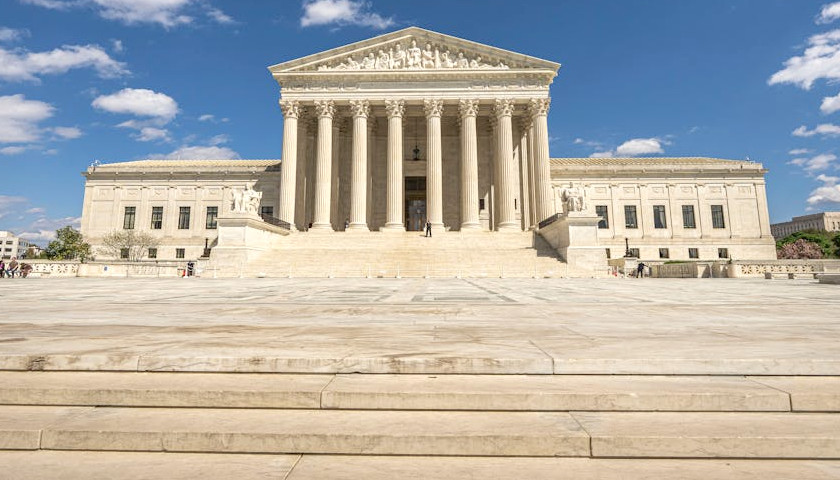
In June, the Supreme Court ruled 6-3 in Trump v. Barbara that Trump’s executive order ending automatic birthright citizenship for children born in the United States to parents who are unlawfully or temporarily present in the country violated the 14th Amendment.
Chief Justice John Roberts wrote for the majority that such children “are citizens at birth” under the Constitution, while Justice Brett Kavanaugh wrote separately that Congress could amend federal law governing citizenship eligibility.
Last week, Banks and Gill announced they have drafted the “Citizenship Act,” legislation that would classify individuals who enter the United States illegally or for the purpose of birth tourism as “invaders” and amend the Immigration and Nationality Act to deny automatic citizenship to their children.
Discussing the proposal during The Michael Patrick Leahy Show, Pulliam suggested Roberts intended the Court’s decision to end the legal debate over birthright citizenship but instead may have sparked a new one.
“I think John Roberts was hoping that this would end the debate over this topic,” Pulliam said. “But as Jonathan Adler, who now teaches at William & Mary, wrote at the time, instead of settling the debate, it may have instead kindled a new one. And already that new debate has taken off in one direction.”
Pulliam pointed to the legislation introduced by Banks and Gill as the latest development in that debate, arguing the legislation attempts to build on language contained in both the Court’s decision and earlier Supreme Court precedent.
“A lot of people were scratching their heads saying, ‘How can we get around this terrible decision,’ which tried very hard to take the issue of birthright citizenship out of the hands of the executive and even out of the hands of Congress,” Pulliam said. “Jim Banks and Brandon Gill are pretty smart and they studied the issue and what they saw is that all John Roberts’ decision in Trump v. Barbara did was basically take this concept of jus soli—birth of the soil. If you’re born here, you’re a citizen automatically.”
Pulliam said Roberts relied heavily on the Supreme Court’s 1898 decision in United States v. Wong Kim Ark, but argued that precedent contains exceptions.
“What he forgot was that Wong Kim Ark, by restating this British common law principle of jus soli, it’s not an absolute doctrine,” Pulliam said. “You are a citizen if you’re born in the United States, except—and there are several exceptions—and one of the exceptions were for children born of alien enemies in hostile occupation.”
According to Pulliam, the legislation seeks to invoke that historical exception by redefining certain illegal entrants as invaders.
“What this proposed legislation, which they call the Citizenship Act, does is to declare that the tens of millions of illegal aliens who have poured across our borders in violation of federal law are in fact an occupying force. They’re hostile to our republic. They’re acting in defiance of our laws, and that therefore they are invaders in the sense of what Wong Kim Ark said was an exception to birthright citizenship,” he explained.
Pulliam also cited the Supreme Court’s 1942 decision in Ex parte Quirin, which involved Nazi saboteurs captured after entering the United States during World War II, arguing that it supports Congress’s ability to treat questions involving invading forces as political questions beyond judicial review.
“The great thing about this argument is that Wong Kim Ark unquestionably has an exception for children born of an occupying force,” Pulliam said. “In Ex parte Quirin, a 1942 case, a group of Nazi saboteurs landed on our shores dressed in civilian clothing… the Roosevelt administration took the position that these people were enemy combatants.”
“If this question of is somebody an occupying force, a combatant, is under Supreme Court case law considered to be a political question, which is outside the purview of judicial review… Jim Ho… has now come around in his position and saying birthright citizenship in the abstract is one thing, but when you have an invasion by an occupying force, that’s different,” he added.
Pulliam added that Fifth Circuit Judge James Ho has written opinions agreeing with Texas Governor Greg Abbott’s characterization of illegal immigration as an invasion and suggesting courts have limited authority to second-guess such political determinations.
Leahy described Pulliam’s analysis as identifying a possible legal roadmap following the Court’s decision.
“This is a very exciting development because you can see the path,” Leahy said.
The legislation from Banks and Gill follows Justice Kavanaugh’s concurring opinion in Trump v. Barbara, where he wrote that although Trump’s executive order conflicted with existing federal law, “Congress could amend” the statute governing birthright citizenship or enact new legislation creating additional exceptions.
Banks and Gill’s proposal seeks to do so by classifying illegal entrants and birth tourists as “invaders,” arguing that children born to those individuals would fall within a historical exception recognized in Wong Kim Ark.
Tune in now to The Michael Patrick Leahy Show – your AMERICA FIRST news talk!
– Watch LIVE here on X
– Watch LIVE on YouTube / Rumble / Roku / AppleTV
– Listen on Spotify
– Listen on WENO AM760 in Nashville
– Read more at @TheTNStarhttps://t.co/64oMLoLej3— Michael Patrick Leahy (@michaelpleahy) July 27, 2026
– – –
Kaitlin Housler is a reporter at The Tennessee Star and The Star News Network.